Search results for tag #solar
![[?]](https://mastodon-media.fgnvm.upcloudobjects.com/accounts/avatars/109/336/582/632/115/804/original/2d36c33cd868d7cb.jpeg)
New #blog post: Adding A Balcony #Solar Install to our garage
We've had solar for nearly 3 years now, but our easterly exposure has been niggling at me: output starts waning around lunch so the afternoon feels wasted (particularly after a cloudy morning)
So, I've added some west facing panels to the garage using a plug-in solar kit
This post talks about the install, setting up monitoring with #telegraf as well as results in the week since
https://www.bentasker.co.uk/posts/blog/house-stuff/adding-plugin-solar-to-our-capacity.html
![[?]](https://files.techhub.social/accounts/avatars/110/125/136/651/538/699/original/865f02928170d952.png)
I've built a webring for solar powered websites and hosted it on squeak! - https://squeak.solarcene.community/webring/
and to make it even better @alipunk has designed a 88x31 graphic - here is a big version
Get in touch if you'd like to join.

Alt...
Squeak is a cool bad that is cleaning a solar panel, in the background are rolling hills.
![[?]](https://files.mastodon.social/accounts/avatars/109/245/191/741/397/935/original/b37f649798bb8caa.jpg)
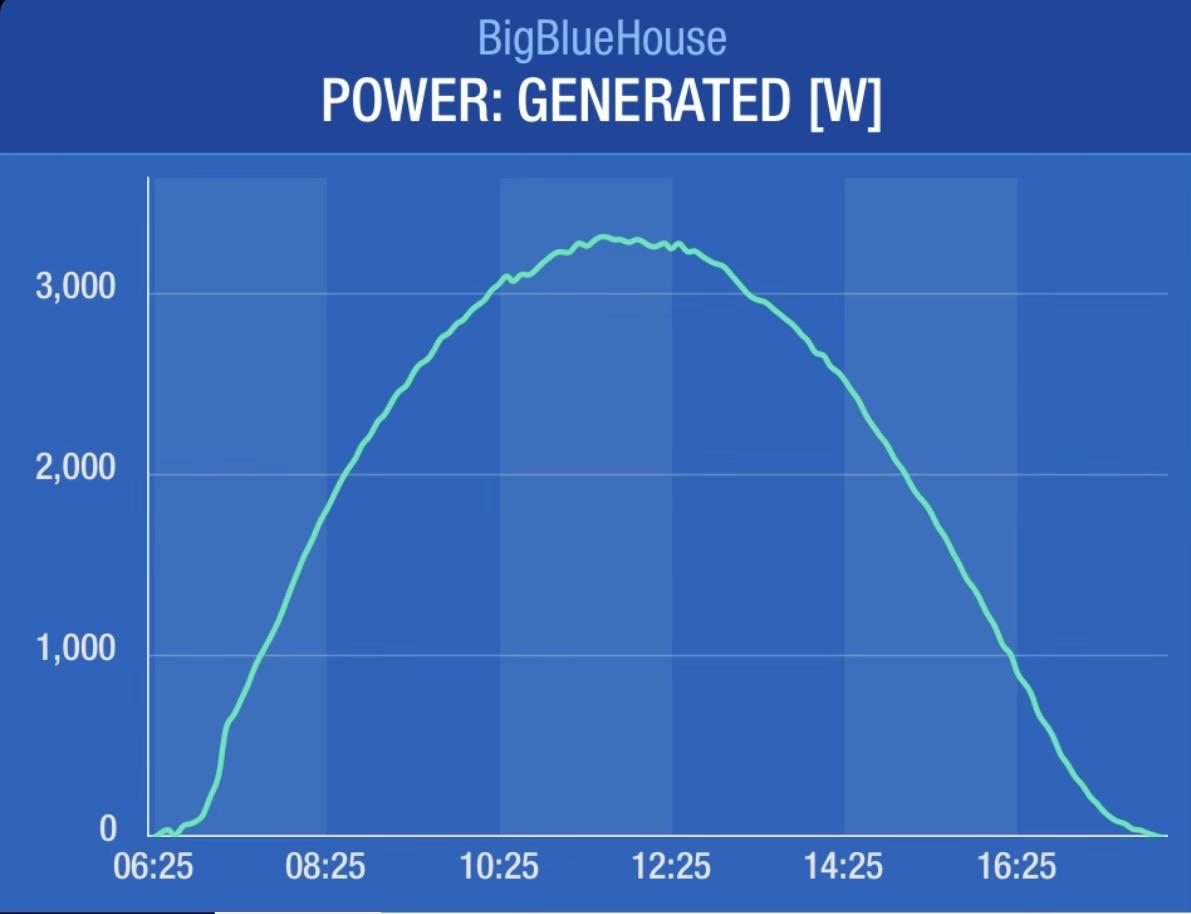
Wow. 23kWh in March! #solar
Alt...
A line graph showing power generation in watts over time in a perfect bell curve. The x-axis indicates time from 06:25 to 16:25, while the y-axis ranges from 0 to 3,000 watts.
![[?]](https://files.mastodon.social/accounts/avatars/000/007/112/original/388649acb2026701.webp)
Brilliant news! The UK's Labour Government are going to make "plug in solar" legal.
Grab some panels from Lidl, hang them off your balcony or out your window, plug them in to your mains. Done!
https://www.gov.uk/government/news/government-to-go-further-and-faster-in-becoming-energy-secure
![[?]](https://stockroom.wandering.shop/accounts/avatars/109/322/377/521/614/269/original/8c8f3798f3276588.jpeg)
I also recommend folks check out (and support!) Solar United Neighbors-- they're an advocacy group that helps navigate issues around solar install regulations and they run solar co-ops to get cheaper pricing by having people go solar together!
![[?]](https://social.v.st/system/accounts/avatars/109/360/452/395/342/558/original/ee08367ecd483af9.png)
On the plus side, once you've got your solar panels and associated support kit (batteries, inverters, etc...). They do tend to have a very good operating life, and as long as the atmosphere keeps letting sunlight through, will continue to generate power.
Maybe we should all be installing some more solar while the supply chains are functioning...
#Solar
3/3
![[?]](https://shkspr.mobi/blog/wp-content/uploads/2023/07/cropped-avatar.jpeg)
30 months to 3MWh - some more home battery stats
https://shkspr.mobi/blog/2026/02/30-months-to-3mwh-some-more-home-battery-stats/Back in August 2023, we installed a Moixa 4.8kWh Solar Battery to pair with our solar panels. For the last year and a half it has chugged away slurping up electrons and sending them back as needed. Its little fan whirrs and the lights on its Ethernet port flicker happily as it does its duty.
I estimate that it has saved us around 3 MegaWatt hours since it was commissioned. In monetary terms, that's roughly £1,000 taken off our electricity bills.
How did I work that out? Well, maths is hard, as Barbie knows, so take all this with a pinch of monosodium glutamate.
Here's a typical month - October 2025:
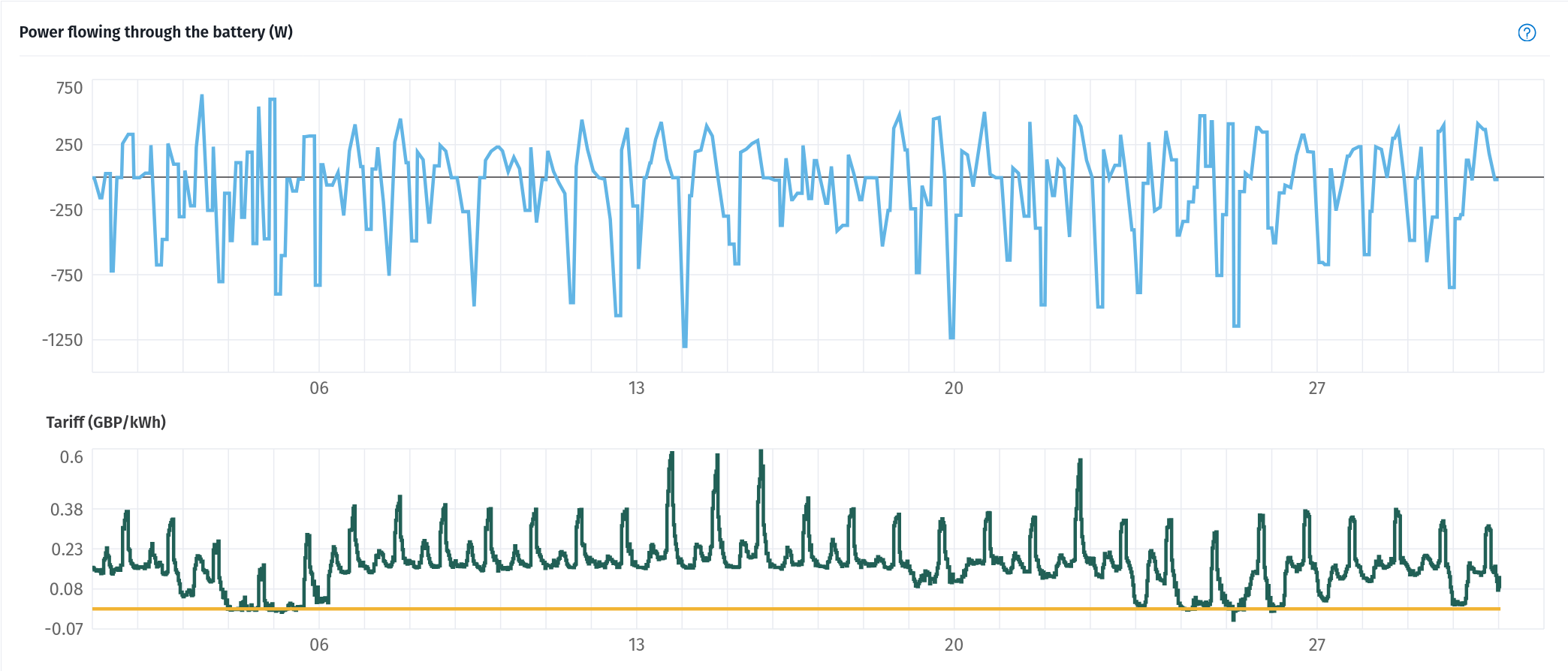
Yikes! What's going on here?
We use a variable electricity tariff. Prices fluctuate every 30 minutes. At peak times our electricity prices can shoot up to 60p per Kwh. Overnight or when the wind is high, prices can drop to zero. Yes, free electricity! Sometimes the excess in the grid means that prices go negative and we are paid to use electricity. Hurrah!
Our battery knows this. Its Internet connection allows it to download the tariff for the day ahead and plan accordingly. If the electricity prices are cheap, the battery fills up. The battery can decide to discharge when we're using more electricity than solar provides, or it can wait until prices are more expensive after the sun has gone down.
Here's an example, again from October:
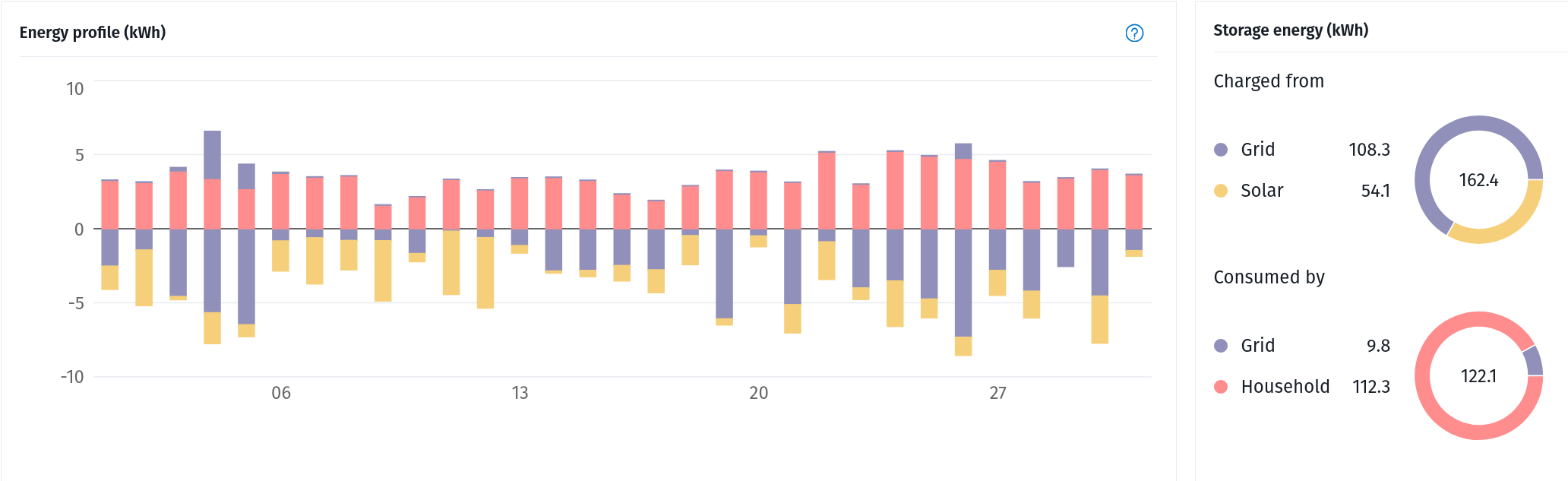
In October, about a third of the power stored in the battery came from the sun. About 92% was used by our house with the remainder being sold back to the grid if it was profitable to do so.
By contrast, here's June 2025 - a sunny month in the Northern Hemisphere:

Here, only 12% of the battery charging was done by the grid. 88% was done for free by solar power. But because solar was so plentiful, about 15% of the battery was sold back to the grid.
Maths. Is. HARD!
I've been playing around with various charts, graphs, spreadsheets, modellers, and a bit of calculus. I basically came to the conclusion that the easiest way was to assume I was saving the energy price capped value of a kWh.
That varies from 25p to 35p. If I fudge the numbers just right, it rounds off at an even grand.
It's Payback Time
No-one ever asks what the payback period is of buying a car vs taking public transport. You never see anyone amortising an engagement ring over the length of a marriage. Still, here we are.
We paid £2,700 for the supply, install, and commissioning of our battery.
That means the payback time for the battery will be between 6 and 7 years. If energy prices go up, the payback time goes down. Its capacity is showing no degradation yet and I hope it will provide us with many years of savings before it needs to be repaired or upgraded.
Solar batteries are getting cheaper and their capacity is getting bigger - although not big enough to store all my home's electricity.
If you can afford the upfront costs, it's like pre-paying for a chunk of your energy usage and can help protect you against sudden price rises.
You can sign up to Octopus and get a £50 bill credit if you want to switch to a variable tariff.
#battery #moixa #solar🆕 blog! “30 months to 3MWh - some more home battery stats”
Back in August 2023, we installed a Moixa 4.8kWh Solar Battery to pair with our solar panels. For the last year and a half it has chugged away slurping up electrons and sending them back as needed. Its little fan whirrs and the lights on its Ethernet port flicker happily as it does its duty.
I estimate…
👀 Read more: https://shkspr.mobi/blog/2026/02/30-months-to-3mwh-some-more-home-battery-stats/
⸻
#battery #moixa #solar
![[?]](https://mastodon.me.uk/system/accounts/avatars/108/582/663/341/900/948/original/d6ca3941781b05ea.jpeg)
For I think the first day since probably October, we’ve had enough sun to recharge the batteries back to 100% after the heat pump hot water cycle first thing, plus cover our daytime usage 😀
And it’s still only Feb 👍
![[?]](https://kolektiva.social/system/accounts/avatars/109/367/437/697/238/997/original/9ab1f56484688a16.jpg)
Hey, so, if anyone comes across useful information about #Solar, #Renewables, etc. on #USGovt websites, I would make the effort of archiving them on the #InternetArchive. They may not be up for much longer. (I just found some great information about Solar on farms, but I expect that to go away soon...)
![[?]](https://freiburg.social/system/accounts/avatars/108/239/253/698/405/813/original/1ab428e772cd8ddf.jpeg)
#Solar is inevitable in #California and the entire #UnitedStates - thats why we support Scott Wiener’s Senate Bill 868 https://www.ewg.org/news-insights/news-release/2026/01/california-senator-introduces-balcony-solar-bill-lower-energy
#senatebill868 #solar #california

![[?]](https://f2.tchncs.de/accounts/avatars/000/005/899/original/e25b9214df0b7bc5.jpg)
A company in #Wales which installed #solar power, #heatpumps and #insulation has gone into administration with all 300 #jobs lost..
https://www.itv.com/news/wales/2026-01-11/hundreds-of-jobs-lost-as-energy-firm-enters-administration
The Clean Energy States Alliance has published a report on “What States Need to Know about #PlugInSolar”.
The report is summary about #balconysolar from an #American perspective.
Although we think the German prices are calculated a little bit to high, because we think you can have installation cost as low as 0,28 EUR/Wp, its a good overview.
It also contains a cost return calculator for #solar on the balcony for #US Consumers.
Amongst other the report also mentions #CPAP machines as good examples for #emergencypower use, higlighting the systems ability to provide #electrictiy even during #grid failure, if you have battery!
https://balkon.solar/news/2026/01/10/us-plug-in-solar-cost-recovery-calculator/

![[?]](https://media.mstdn.social/accounts/avatars/109/296/491/552/176/271/original/e6279b8249a4868b.jpeg)
Another test to see how stupid #Starmer and the current #Labour administration think the electorate are .
If he thinks he can water down proposed requirements to include batteries with new build homes and no one will notice he’s the short term thinking fool.
Most social housing tenants question why they are currently offered #solar panels but no battery storage.
RE: https://freiburg.social/@balkonsolar/115754433974727816
At Germany’s equivalent of Home Depot you can get a 445 W solar panel for €69, an inverter for 109€ and mounting for 49€, cables for 29€. And this isn’t the cheapest offer.
Things I'd do differently with my #solar / #battery / #heatpump if I'd known - #1....
I'd buy more battery. Not so much of an issue in summer due to the solar, but in winter we could easily time-shift double our current capacity (i.e. charging at cheap rate, discharging during peak rate).
As it is our 10kWh is usually done by lunchtime or early afternoon, especially when the heatpump is doing it's thing and it's a dull day.
Will know for next tine 🤷🏻
![[?]](https://files.mastodon.social/accounts/avatars/109/246/078/948/794/953/original/13e2ecd309465b55.gif)
#Ecoflow #recall more batteries. Like the previous recalls it's relatively old tech. Unlike the last recalls it's getting a firmware update not a physical recall
Not clear if non US units are affected but these are older explody NCM battery cells not modern much safer LFP ones used in the Delta 2 or later I believe so this is not something you want to ignore.
![[?]](https://media.mstdn.social/accounts/avatars/109/290/579/328/697/081/original/4d68778018e8f584.jpg)
Advice please! We think we have enough money to either a) swap out our gas boiler for an air-source heat pump or b) get solar. Which one is the best to prioritise? We're in the UK.
#solar #GreenEnergy #AirSourceHeatPump #zerocarbon
| Air source heat pump: | 20 |
| Solar: | 10 |
| I want to see the results!: | 8 |
![[?]](https://cdn.masto.host/mymastocom/accounts/avatars/114/957/080/947/055/598/original/58bd77811dd5df64.jpg)
Australians to get at least three hours a day of free solar power - even if they don’t have solar panels
Labor announces ‘solar sharer’ program for households in NSW, south-east Queensland and South Australia
 boosted
Cheap #solar panels are changing the world.
But there is a dark side to this technological progress. The consequences of relying too much on solar power could be devastating.
Read on:
https://shkspr.mobi/blog/2023/11/chapter-16-here-comes-the-sun-god/
![[?]](https://cdn.masto.host/writing/accounts/avatars/109/291/038/958/941/506/original/47bbff496a96ed5c.jpg)
Remember the massive blackout in Spain last year? When some people had no electricity for about 24h?
Back then, the blame was immediately put on renewables, pushing the claim that wind and solar are unreliable.
Well, the answers are in, and that was a big, fat lie by media beholden to the fossil fuel industry:
https://www.npr.org/2025/10/08/nx-s1-5534949/spain-blackout-misinformation-renewable-energy
Unfortunately, too many people believe this crap. The opposite is true: renewables paired with batteries stabilize the net.
![[?]](https://media.mastodon.scot/accounts/avatars/109/252/274/874/045/781/original/172e8f7530627e87.png)
It's widely reported that #China has been building out huge amounts of #solar photovoltaic generation, and of course that is a big contributor to slowing #ClimateChange. But what I discovered to my surprise this week is that China is also #Reforesting faster than almost anywhere else on Earth, which is an equally important contributor, and also contributes positively to the #Oxygen cycle.
![[?]](https://media.beige.party/accounts/avatars/112/375/473/736/525/017/original/9ce2e92da116f4a4.jpg)
I remember many people (mostly white folks) telling me that I'm crazy & have no idea what I was talking about - when I told them that while Global North kept ignoring opportunities for shifting to more #SolarPower & more #WindEnergy to move away from #FossilFuels as part of longterm #EnergyProducing plans/infrastructure, China was going to kick global ass with their full investments on wind & solar #AlternativeEnergy. I said that in 1996.
China became the world's leading installer of #photovoltaics in 2013. China surpassed Germany as the world's largest producer of photovoltaic energy in 2015 & became the first country to have over 100 GW of total installed photovoltaic capacity in 2017. As of 2024, Chinese firms are the industry leaders in almost all of the key parts of the solar industry supply chain, including polysilicon, silicon wafers, batteries & photovoltaic modules.
#WindPower remained China's 3rd largest source of #electricity at the end of 2021, accounting for 7.5% of total power generation.
China is forecast to have 1200 GW of combined #wind & #solar capacity by 2030 as part of the government's pledge to increase the share of non-fossil fuels in primary #energy consumption to around 25% by that year.
Both wind & solar energy industries in China have created thousands of sustainable jobs as well. They have boosted the Chinese economy from within.
#AsianMastodon #DivestFromFossilFuels #GlobalSouth #ChineseEnergyIndustry
![[?]](https://media.hachyderm.io/accounts/avatars/109/309/207/375/811/790/original/a87d009807f38fa3.jpeg)
#RenewableEnergy overtook #coal as world's leading source of #electricity in first half of #2025 - a historic first.
Electricity demand is growing around world but growth in #solar and #wind was so strong it met 100% of the extra electricity demand, even helping drive a slight decline in coal and gas use.
Developing countries, especially #China, led the clean energy charge but richer nations including the #US and #EU relied more than before on planet-warming #fossilfuels.
https://www.bbc.com/news/articles/cx2rz08en2po
![[?]](https://social-coop-media.ams3.cdn.digitaloceanspaces.com/accounts/avatars/000/084/223/original/a9a3e78dce8212e0.jpg)
Anyone else around #Wirral #Liverpool going to see the Power Station film on Tuesday? https://power.film/ "Two artists in Walthamstow set out to take their street off the grid, kickstarting a #solar -powered energy revolution." #NewBrighton screening is 6pm https://newbrighton.thelight.co.uk/power-station #SolarPunk